

How Often Should You Feed a Kitten? Schedule by Age
Short answer: Until they are six months old, kittens will usually do best when fed three meals a day. Between six months and one year, twice a day is generally best. That is the guidance from the Cornell Feline Health Center, and it is a good starting point for most kittens that have been weaned and are eating solid food. Your vet can adjust it for your kitten's size, growth and health, so bring it up at the first visit.
Why do kittens eat more often than adult cats?
Kittens are growing fast, and Cornell explains that they require more food per pound of body weight than adult cats, so they should be fed more often through the day. Small, frequent meals suit a small body.
It is also easier to keep an eye on a kitten that eats on a rhythm. You see how eagerly they finish a bowl, how they act afterward, and whether anything changes. If your kitten suddenly stops eating or seems off, call your vet.
Kitten feeding schedule by age
The table below follows Cornell's guidance for kittens that are eating solid food.
| Age | Meals per day |
|---|---|
| Weaned up to 6 months | 3 |
| 6 months to 1 year | 2 |
| Adult (about 1 year and up) | 1 or 2 |
Cornell notes that once a cat becomes an adult, at about one year of age, feeding once or twice a day is appropriate in most cases. The American Animal Hospital Association (AAHA) and American Association of Feline Practitioners (AAFP) life stage guidelines define the kitten stage as birth up to one year, which lines up with these timelines.
What about very young kittens? Kittens that are still nursing, or that have just been weaned, may need a different plan, including more frequent meals. That is a conversation for your vet. These ages are outside what this post covers.
Sample day: feeding a kitten three meals a day
Kittens like routine. Here is one way to set it up:
- Morning (around 7 a.m.): First meal before you leave or start your day.
- Midday or afternoon (around 1 to 3 p.m.): Second meal. If you work away from home, a family member, pet sitter or timed feeder can help.
- Evening (around 7 p.m.): Third meal, ahead of your own wind-down.
Exact times matter less than keeping them roughly consistent from day to day. Wash the bowl between meals and pick up what is not eaten after a while, especially wet food.
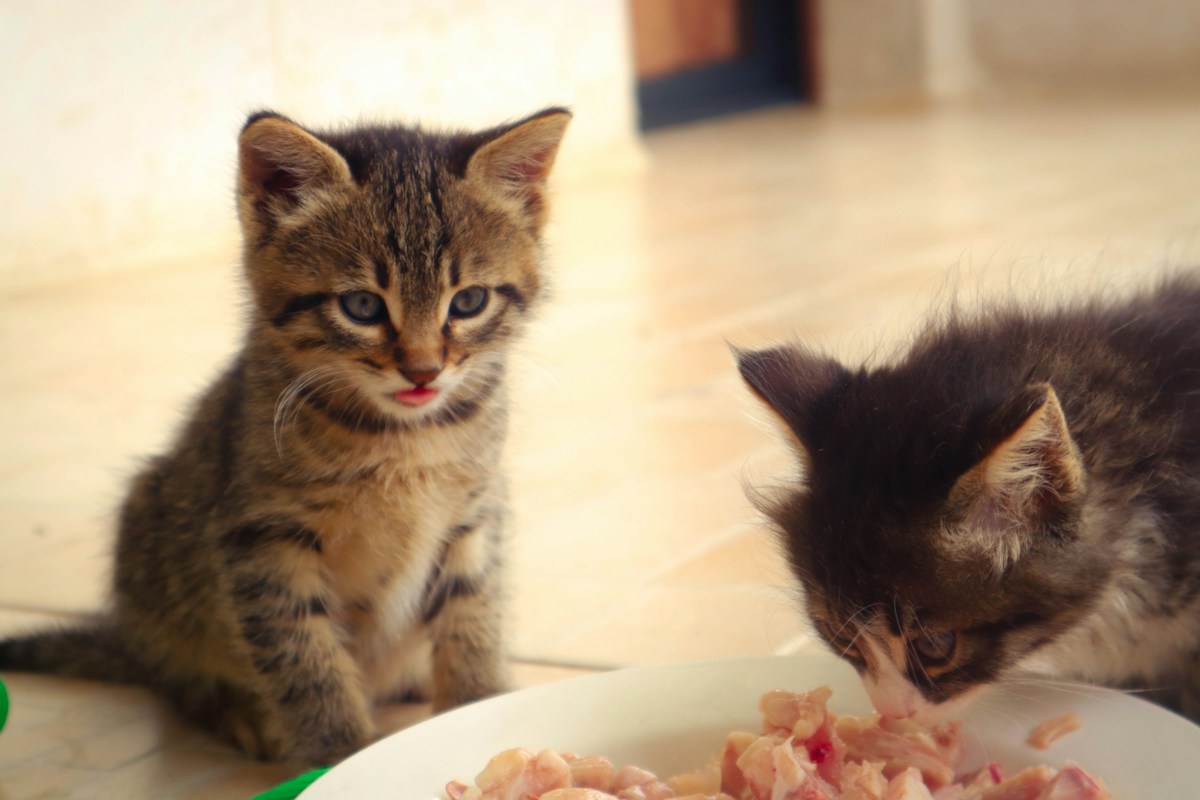
Wet food or dry food for kittens?
Cornell says wet cat food is typically about 70 to 80 percent water and can be fed in addition to or instead of dry. For a kitten, a few things to think about:
- Wet food adds water to the day. Canned food is at least 75 percent water, compared with 6 to 10 percent for dry food (Cornell). Kittens, like adult cats, do not always drink as much as you would like. See how much water cats get from wet vs dry food.
- Structured meals are easy with wet food. It is served and finished, then gone.
- Mixing is fine. Many households use wet food for meals and a little dry food in a puzzle toy.
Whatever you choose, pick a food labeled for your kitten's life stage, and use it as written on the label.

How much should a kitten eat at each meal?
There is no one number. Feeding amounts on food labels are based on the needs of the average cat, so they are a place to start, not a rule. Cornell points out that you may be feeding more than necessary if a cat spends less energy than average.
A few habits help:
- Follow the label as a starting point. Split the daily amount across the meals.
- Watch your kitten, not just the bowl. A healthy, growing kitten is active, bright and eager to play. Cornell describes a physically sound kitten as active, bright, responsive, rambunctious, and eager to join in play.
- Weigh at vet visits. Your vet can tell you if growth is on track and whether to change the amount.
- Ask before changing a lot. Large jumps in portion size, or skipped meals, are worth a call.
Should you leave food out for a kitten all day?
Cornell says free feeding dry food, keeping it available all the time, may be acceptable for some cats, but for others it can result in overeating and inappropriate weight gain. Scheduled meals make it simpler to see how much your kitten eats and to avoid creeping extra portions.
Meals are also a habit your kitten carries into adulthood. A cat used to two or three meals a day often finds it easy to follow the same pattern for life.
How to change a kitten's food without an upset tummy
Kittens, like adult cats, can be fussy about change. Whenever you switch, take your time.
- Mix a small amount of the new food into the old one.
- Increase the new food a little each day over a week or more.
- Watch appetite and the litter box. If something seems off, pause and call your vet.
Set up the feeding spot well
Cornell recommends separate food and water dishes for a new cat, kept far from the litter box. A quiet corner, a shallow dish a small kitten can reach and a fresh bowl of water close by will make mealtimes smoother. If you have other cats, Cornell advises keeping the new kitten separated from them until your veterinarian has had a chance to examine the newcomer, which also means separate bowls at first.
What to ask your vet
Bring these to the first checkup (our cat checkup guide by life stage has the full schedule):
- Is my kitten's weight on track?
- How many meals, and how much food, should I serve right now?
- When should we move from three meals to two?
- Is there anything about the food I am using that you want to change?
The bottom line
For most weaned kittens, three meals a day until six months, then two meals a day up to a year, is a sound plan according to Cornell. Keep meals regular, use a food made for your kitten's life stage, give fresh water, and check in with your vet as your kitten grows.
If you are still picking a first food, our kitten trial box lets you try four recipes of our fresh, preservative-free wet food and see which one your kitten likes best, before you stock up.

This post is for general information. It is not veterinary advice. For your kitten's feeding plan, growth or any health concern, talk to your vet.
Frequently asked questions
How many times a day should a kitten eat?
Cornell says kittens usually do best fed three meals a day until they are six months old, then twice a day from six months to one year. This applies to kittens that are weaned and eating solid food. Your vet can adjust the plan.
How often should I feed a 3-month-old kitten?
A weaned 3-month-old kitten falls in the under-six-months group, so Cornell's guidance is three meals a day. Split the daily amount on the food label across those meals and ask your vet if growth is on track.
When can I switch my kitten from three meals to two?
Cornell's guidance moves kittens to two meals a day between six months and one year. Ask your vet at a checkup when to make the change for your kitten.
Should I leave food out for my kitten all day?
Cornell says free feeding dry food may be acceptable for some cats, but for others it can lead to overeating and weight gain. Scheduled meals make it easier to see how much your kitten eats.
Can a kitten eat only wet food?
Cornell says wet cat food, typically about 70 to 80 percent water, can be fed in addition to or instead of dry food. Choose a food labeled for your kitten's life stage and follow the label, and ask your vet about your kitten's plan.
How much should a kitten eat?
There is no single number. Label amounts are based on the average cat, so use them as a starting point, split across meals, and watch your kitten. A healthy kitten is active, bright and eager to play. Your vet can tell you if the amount needs to change.
Sources
- Cornell Feline Health Center, "How often should you feed your cat?": until six months kittens usually do best fed three meals a day; six months to one year, twice daily; adults once or twice a day; wet food is typically about 70 to 80 percent water; free feeding dry food may lead to overeating for some cats; label amounts are for the average cat. https://www.vet.cornell.edu/departments/cornell-feline-health-center/health-information/feline-health-topics/how-often-should-you-feed-your-cat
- Cornell Feline Health Center, "Feeding Your Cat": canned food at least 75 percent moisture; dry food 6 to 10 percent. https://www.vet.cornell.edu/departments-centers-and-institutes/cornell-feline-health-center/health-information/feline-health-topics/feeding-your-cat
- Cornell Feline Health Center, "Choosing and Caring for Your New Cat": separate food and water dishes kept far from the litter box; keep a new cat apart from other cats until a vet has examined them; a sound kitten is active, bright, responsive, rambunctious and eager to play. https://www.vet.cornell.edu/departments-centers-and-institutes/cornell-feline-health-center/health-information/feline-health-topics/choosing-and-caring-your-new-cat
- AAHA/AAFP Feline Life Stage Guidelines (2021), summary at catvets.com: kitten stage is birth up to 1 year. https://catvets.com/news/updated-feline-life-stage-guidelines/
